
Published: May 04,2026
The quarterly marketing review has a familiar dynamic in many retail businesses. The marketing team presents campaign metrics — impressions, clicks, open rates, engagement rates. The CFO asks how much revenue those campaigns generated and whether the spend was worth it. A long, uncomfortable silence follows. The truth is that most retail marketing teams struggle to connect their activities directly to revenue outcomes in a way that satisfies rigorous financial scrutiny — and this gap undermines both the credibility of the marketing function and the quality of investment decisions.
The good news is that this problem is entirely solvable. The right metrics, the right measurement approach, and the right analytical tools can make the ROI of every marketing campaign clear, credible, and compelling. Here is a practical framework for getting there.
Open rates, click-through rates, follower counts, and engagement rates are not meaningless, but they are not ROI. A CFO who asks whether the marketing budget generated a return is not asking about email opens. They are asking: did we get more money back than we spent? And if yes, how much more, and with what level of confidence?
The shift required is from activity metrics to outcome metrics. Activity metrics — how many emails were sent, how many people opened them — tell you what happened. Outcome metrics — how much incremental revenue was generated, how many customers were retained who would otherwise have churned, what was the return on the promotional investment — tell you whether it was worth doing.
Most retail marketing teams track activity metrics because they are easy to collect from email and social platforms. Outcome metrics require a connection between marketing activity and actual purchase behaviour in your transaction data. Building that connection is the fundamental challenge — and the fundamental opportunity.
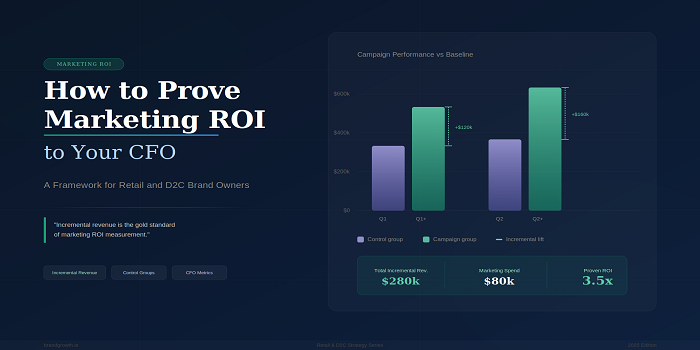
Incremental revenue is the gold standard of marketing ROI measurement. The question is not how much revenue did we make in the period when this campaign ran, but how much additional revenue did we make as a direct result of this campaign, above and beyond what we would have made anyway? Answering this requires a control group — a segment of comparable customers who did not receive the campaign — and the discipline to measure the difference in behaviour between the two groups.
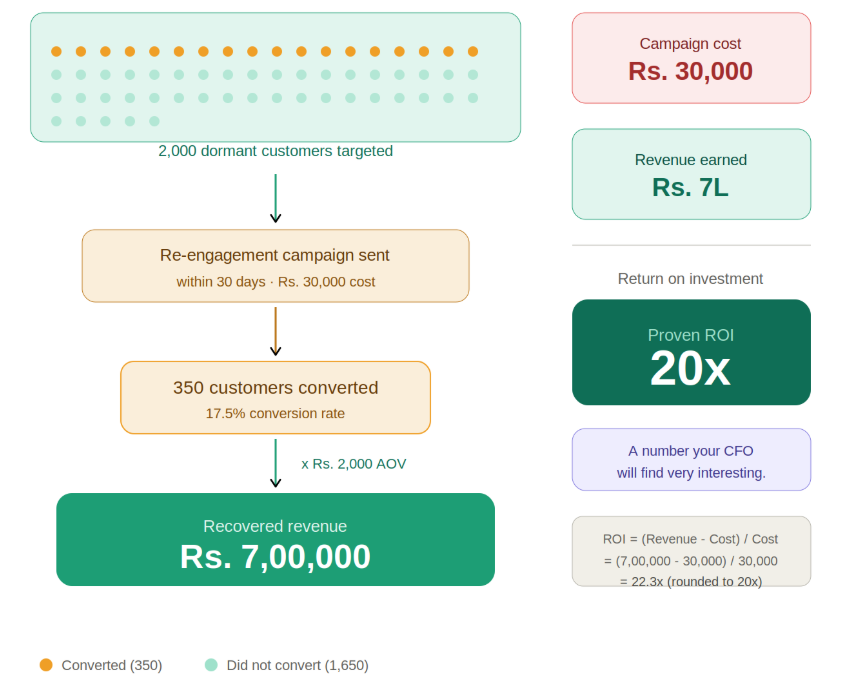
Repeat purchase uplift is the metric most directly relevant to loyalty and retention campaigns. If your re-engagement campaign targeted 2,000 dormant customers and 350 of them made a purchase within 30 days at an average order value of Rs. 2,000, your campaign generated Rs. 7 lakh in recovered revenue. If the campaign cost Rs. 30,000 to execute, the ROI is over 20 times. That is a number a CFO will find very interesting.
Reactivation rate and churn reduction rate are equally powerful. If your churn rate drops from 5 percent per month to 3.5 percent as a result of your retention programme, and your average customer lifetime value is Rs. 8,000, the value of that 1.5 percentage point reduction can be calculated precisely and presented compellingly as a return on your customer success investment.
Customer lifetime value improvement is the ultimate long-term ROI metric. When you can show that customers who receive personalised communications have a CLV that is 40 percent higher than those who do not, you have a CFO-ready business case for every incremental investment in data and marketing technology.
Attribution — determining which marketing activities deserve credit for which revenue outcomes — is where most retail brands get stuck. Multi-touch attribution across WhatsApp, email, SMS, and in-store interactions is genuinely complex. But it does not need to be perfect to be useful.
Start with simple, credible measurement. For re-engagement campaigns, compare the 30-day purchase rate of the targeted segment to a matched control group of similar customers who were not targeted. For loyalty programmes, compare the purchase frequency and spend of enrolled customers to non-enrolled customers with similar historical behaviour. For NPS recovery campaigns, track the subsequent purchasing behaviour of recovered Detractors versus those not contacted.
These simple comparisons will not capture every nuance of multi-touch attribution, but they will give you clear, defensible numbers that your CFO can evaluate against the cost of the campaign. And they will build the habit of outcome-based thinking across your marketing team.
The most effective way to make marketing ROI visible and credible is to have a dedicated dashboard that tracks the outcomes that matter in real time. When your CFO can see, at any moment, the incremental revenue generated by your re-engagement campaigns, the churn rate reduction driven by your loyalty programme, and the uplift in customer lifetime value from your personalisation initiatives, the conversation shifts from justifying marketing spend to optimising it.
This kind of visibility transforms the marketing function from a cost centre into a revenue centre — and that shift in perception is worth as much as any individual campaign improvement. When marketing can demonstrate its ROI clearly and continuously, it earns the investment and the trust it needs to drive the strategies that compound into long-term brand growth.
Building this capability requires the right data infrastructure, the right analytical tools, and a commitment to measuring what matters rather than what is easy. But the investment pays for itself quickly — both in better marketing decisions and in the organisational credibility that comes from being able to prove, with rigorous data, that every rupee spent on customer retention is generating a measurable and significant return.
Ready to transform your customer retention and loyalty strategy?
Book a Demo with our LYTTY Experts to explore Lytty's AI-powered platform and start your free trial today.

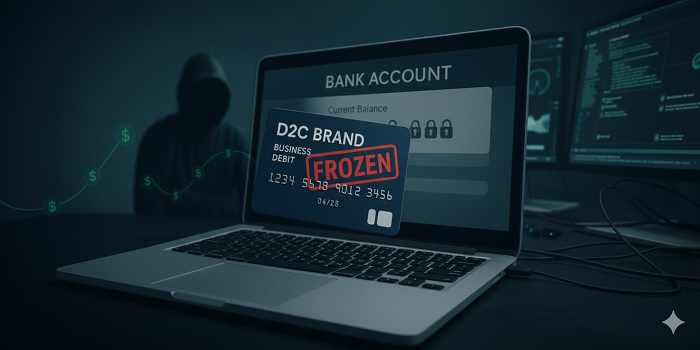
Download the D2C Bank Account Freeze Survival Checklist (Free PDF) and get practical steps to protect your bank account freezes caused by fraudulent transactions.
Thank You! Your Freeze Survival Checklist is on its way
While you're here, don't stop at prevention - learn how leading D2C brands are using LYTTY to :
Or