
Published: May 16,2026
Average order value is one of the most powerful but under-optimised levers available to retail and D2C brands. Unlike customer acquisition — which requires budget, time, and external market dynamics to work in your favour — growing AOV is primarily a function of understanding your customers better and presenting the right additional products at the right moment. And the data you need to do this is already sitting in your transaction history, waiting to be unlocked.
Basket analysis is the practice of studying which products customers buy together, in the same transaction or in close sequence, to identify product affinity patterns. At its simplest, it answers questions like: what do customers who buy this product also tend to buy? Which product combinations are purchased most frequently together? Which products frequently appear in the same basket as your highest-value items?
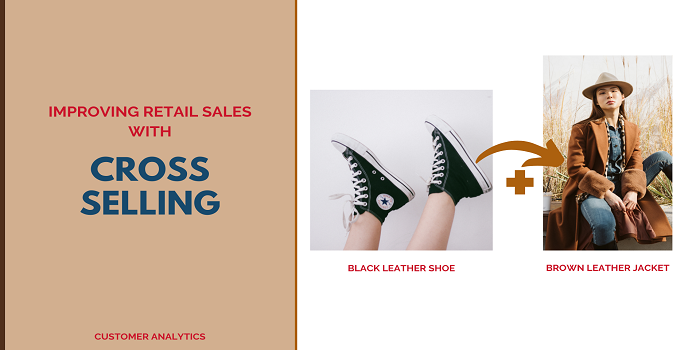
These patterns, once understood, become the foundation for intelligent cross-sell and upsell strategies that feel helpful rather than pushy. When a customer buys a running shoe and you recommend the running socks that 60 percent of running shoe buyers also purchase, you are not selling — you are helping. And that distinction is what makes the difference between a cross-sell that converts and one that gets ignored.
Basket analysis matters because it shifts AOV optimisation from guesswork to data. Instead of randomly bundling products or promoting whatever has the highest margin, you are recommending products based on demonstrated purchase patterns from thousands of real customers.
Not all product affinities are obvious. You might expect that customers who buy formal shirts would also buy formal trousers — that is an intuitive connection. But basket analysis often surfaces surprising relationships that you would never have guessed.
A footwear brand might discover that customers who buy sports shoes are highly likely to also purchase casual sandals within the same month — not because they are looking for both at the time of the first purchase, but because the first purchase signals a broader footwear shopping moment. A beauty brand might find that customers who buy high-end serums are unusually likely to also purchase premium candles — suggesting a lifestyle affinity rather than a product category affinity.
These non-obvious product affinities are often the most valuable, because they represent cross-sell opportunities that your competitors are almost certainly not targeting. Acting on them requires AI-powered analysis rather than intuition — the human brain cannot spot these patterns in a catalogue of hundreds of SKUs across thousands of customers, but an algorithm can do it in seconds.
SKU velocity refers to how quickly individual products sell and how frequently they appear in repeat purchases. Your highest-velocity SKUs — the products that sell fast and drive repeat visits — are your anchor products. They are what many customers come to you for first, and understanding them is key to growing AOV strategically.
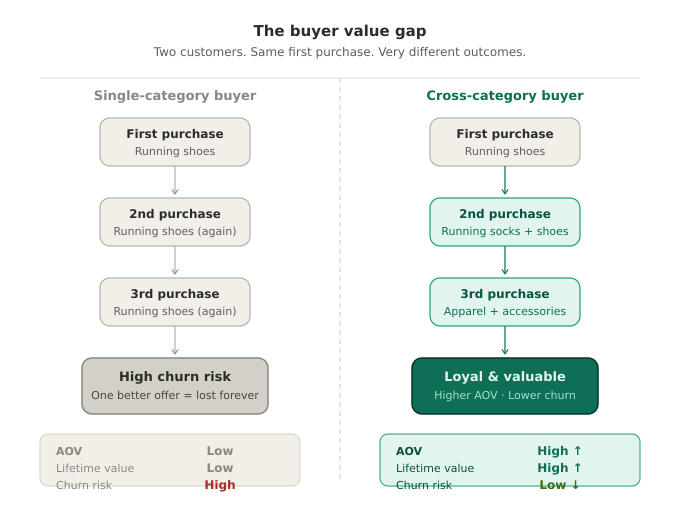
Once you know your anchor SKUs, you can use them as the entry point for category expansion. A customer who has bought your anchor product three times and nothing else is a high-priority target for basket expansion. They clearly trust your brand enough to keep coming back for one thing — but they have not yet discovered everything else you offer.
Cross-category buyers are almost invariably more valuable, more loyal, and less likely to churn than single-category ones. Growing the number of customers who buy from multiple categories in your range is one of the highest-leverage activities a retail brand can pursue.
Timing is everything in cross-sell execution. A recommendation delivered at the point of purchase converts well because the customer is already in buying mode. A follow-up recommendation sent via email or SMS two to three days after purchase — when the customer is enjoying their new product and in a positive frame of mind about your brand — also converts well because it is timely and contextually relevant.
What does not work is the generic product recommendation sent to everyone in your database once a week with no relationship to what they have actually bought. These campaigns generate low engagement, train customers to ignore your communications, and contribute to the impression that you are broadcasting rather than conversing.
AI-driven basket analysis makes precise, timely cross-sell campaigns easy to implement at scale. When a customer purchases a specific product, a trigger fires automatically. The recommendation engine selects the product with the highest affinity and conversion probability for that specific purchase, based on historical data. The message is routed to the customer's most active channel — whether email, SMS, or push notification — at the optimal time. The result is a cross-sell campaign that feels personal and well-timed because it actually is, and that consistently delivers meaningful AOV lifts.
The practical path to using basket analysis to grow AOV starts with data quality. You need clean, complete transaction data that captures what was bought, by whom, and when. Once you have that, the analysis itself is the easy part — the patterns emerge quickly. The value is in acting on them with precision and speed.
Brands that build basket intelligence into their standard marketing workflow — with automated cross-sell triggers, informed bundle recommendations, and category expansion campaigns for single-category buyers — consistently outperform those that do not on both AOV and customer lifetime value. It is one of the clearest examples in retail of where better data directly equals more revenue.
Ready to transform your customer retention and loyalty strategy?
Book a Demo with our LYTTY Experts to explore Lytty's AI-powered platform and start your free trial today.

Download the D2C Bank Account Freeze Survival Checklist (Free PDF) and get practical steps to protect your bank account freezes caused by fraudulent transactions.
Thank You! Your Freeze Survival Checklist is on its way
While you're here, don't stop at prevention - learn how leading D2C brands are using LYTTY to :
Or