
Published: Jun 17,2026
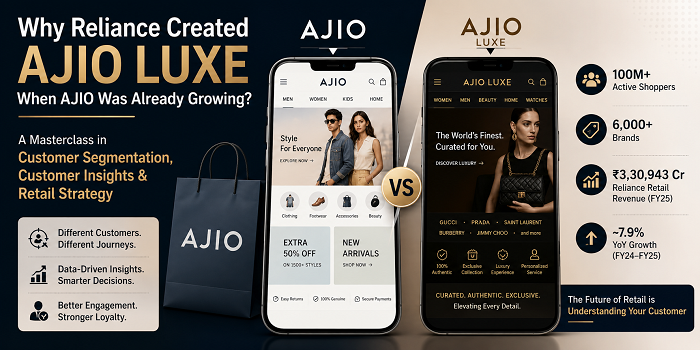
For readers who may not be familiar with the brand, AJIO is the fashion and lifestyle e-commerce platform owned by Reliance Retail, the retail arm of Reliance Industries Limited. Launched in 2016, AJIO has grown into one of India's largest online fashion destinations, offering apparel, footwear, accessories, beauty, and home products. Today, it features over 6,000 brands, millions of product styles, and serves more than 100 million shoppers across India.
You can explore AJIO at https://www.ajio.com, while its premium luxury platform, AJIO Luxe, is available at https://luxe.ajio.com.
Backed by Reliance's extensive retail ecosystem, AJIO combines online shopping with one of India's largest offline retail networks, making it a formidable competitor to Myntra, Amazon Fashion, Tata CLiQ, and Nykaa Fashion.
But despite AJIO's remarkable growth, Reliance made an unexpected strategic move—it launched a second fashion platform called AJIO Luxe.
Why would a successful retailer build a separate luxury platform instead of expanding its existing one?
The answer offers one of the most valuable lessons in Retail Customer Engagement, Customer Segmentation, Customer Intelligence, and Retail Personalization.
|
Attribute |
Details |
|---|---|
|
Brand |
AJIO |
|
Official Website |
|
|
Luxury Platform |
|
|
Parent Company |
Reliance Retail (Reliance Industries Ltd.) |
|
Founded |
2016 |
|
Industry |
Fashion & Lifestyle E-commerce |
|
Business Model |
Omnichannel Fashion Retail |
|
Leadership |
Spearheaded by Isha M. Ambani as part of Reliance Retail |
|
Brands Available |
6,000+ |
|
Product Styles |
3 Million+ |
|
Active Shoppers |
100 Million+ |
|
Estimated AJIO GMV (FY25) |
~US$3.4–3.5 Billion (Industry Estimate) |
|
Parent Company Revenue (FY25) |
Rs.3,30,943 Crore (Reliance Retail) |
|
Revenue Growth (FY24 → FY25) |
~7.9% |
|
5-Year Revenue Growth (FY21 → FY25) |
~115% (≈21% CAGR) |
|
Key Competitors |
Myntra, Amazon Fashion, Tata CLiQ Luxury, Nykaa Fashion, Flipkart Fashion |
.png)
Note:Reliance Retail does not publicly disclose AJIO's standalone revenue or profitability. Industry estimates suggest AJIO generated approximately US$3.4–3.5 billion in Gross Merchandise Value (GMV) during FY25, making it one of India's largest fashion e-commerce platforms.
What every retailer can learn about Customer Engagement, Customer Insights, and Retail Technology from Reliance's fashion strategy.
When Reliance launched AJIO in 2016, its ambition wasn't just to build another fashion e-commerce platform. It wanted to create a technology-driven retail ecosystem powered by digital commerce, customer insights, and personalized shopping experiences.
Over the years, AJIO has become one of India's largest online fashion destinations, serving millions of shoppers across thousands of brands.
But then Reliance made an interesting move.
Instead of expanding AJIO further, it launched an entirely new platform—AJIO Luxe.
At first glance, it seemed unnecessary. After all, both platforms sell fashion online.
So why would one of India's largest retailers invest in building another fashion destination?
The answer lies in one of the most important principles of modern retail:
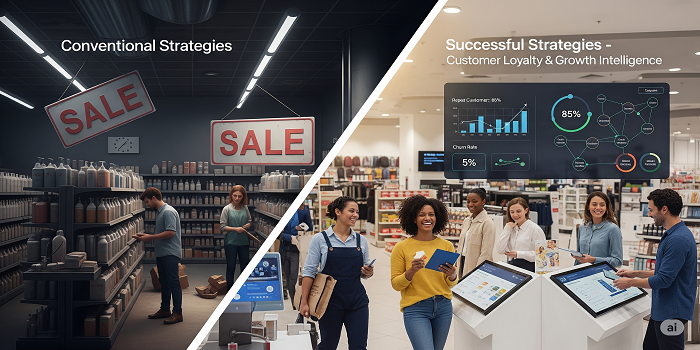
Successful retailers don't simply sell products. They build different experiences for different customers.
One of the biggest lessons from AJIO's evolution is that modern retail is no longer about selling products—it's about understanding customers.
Every purchase, every wishlist, every browsing session, every abandoned cart, and every product return generates valuable customer data.
Retailers who transform this information into actionable Customer Insights can create personalized shopping experiences that improve Customer Engagement, increase Repeat Purchases, and strengthen Customer Loyalty.
This is why leading retailers today invest heavily in Customer 360 platforms, Retail Analytics, Customer Intelligence, and AI-powered Customer Segmentation before investing in more advertising.
AJIO Luxe is not just another website.
It is the outcome of customer intelligence.
One of the biggest mistakes retailers make is assuming every customer shops the same way. In reality, customer behavior varies dramatically across different segments—and the most successful retailers use data, not assumptions, to understand these differences.
A customer buying a Rs.999 T-shirt is often looking for value, discounts, variety, and convenience. Their purchase decisions are influenced by promotions, seasonal offers, and fast delivery.
A customer spending Rs.75,000 on a luxury handbag or over Rs.1 lakh on a premium watch follows a completely different buying journey. They spend more time researching, compare brands, value authenticity over discounts, and expect a seamless, premium shopping experience.
They care about:
The question is—how did Reliance identify these differences?
The answer lies in Customer Insights. By analyzing purchase history, browsing behaviour, average order value, brand preferences, customer lifetime value, and engagement patterns, retailers can identify distinct customer segments and understand what truly drives each of them.
This is where Customer Intelligence becomes a competitive advantage. Instead of offering the same experience to everyone, retailers can create personalized customer journeys for different segments.
Reliance applied this strategy brilliantly.
Rather than positioning luxury products alongside value fashion, it created two distinct experiences.
AJIO caters to customers seeking fashion, affordability, and variety.
AJIO Luxe is designed for affluent shoppers who prioritize exclusivity, premium brands, and elevated service.
This is a textbook example of AI-driven Customer Segmentation and Retail Personalization—using customer data to deliver the right experience to the right customer at the right time.
For retailers, the lesson is clear: the more you understand your customers, the better you can engage them. And stronger customer engagement leads to higher loyalty, better retention, increased customer lifetime value, and sustainable business growth.
Imagine walking into a luxury boutique where designer handbags are displayed next to clearance racks offering 70% discounts.
Even if the products are genuine, the luxury experience disappears.
Luxury brands invest millions in protecting their image.
Everything matters:
Selling premium brands inside a discount-led marketplace weakens that perception.
By launching AJIO Luxe, Reliance gave luxury brands a premium digital environment that matched their positioning.
For luxury customers, perception is often as valuable as the product itself.
Although both belong to Reliance Retail, they are built around entirely different customer journeys.
|
AJIO |
AJIO Luxe |
|---|---|
|
Mass fashion marketplace |
Premium & Luxury destination |
|
Value-conscious shoppers |
Affluent consumers |
|
High transaction volumes |
High-value purchases |
|
Discount-driven events |
Curated shopping experience |
|
Wide assortment |
Carefully selected collections |
|
Trend-led shopping |
Experience-led shopping |
|
Price-sensitive audience |
Brand-conscious audience |
This is one of the best examples of Retail Personalization at a business level.
Instead of forcing every customer through one journey, Reliance created separate retail experiences based on customer behaviour.
Luxury brands don't want to compete on discounts.
Global brands prefer selling through premium environments where pricing, presentation, and customer experience remain under control.
Reliance already had relationships with many international luxury brands through its retail ecosystem.
AJIO Luxe became the digital extension of those relationships.
Instead of asking luxury brands to join a mass marketplace, Reliance built a platform specifically designed for them.
This strengthened trust from both customers and brands.
Many retailers believe growth comes from acquiring more customers.
The smartest retailers know growth comes from understanding customers better.
Luxury shoppers purchase less frequently, but their Customer Lifetime Value (CLV) is significantly higher.
Through advanced Retail Customer Analytics, retailers can identify high-value customer segments, personalize communication, recommend relevant products, and improve marketing ROI.
Instead of offering blanket discounts, they invest in relevance.
That's exactly what customer intelligence enables.
Reliance is gradually positioning AJIO Luxe as a premium lifestyle ecosystem rather than simply another online fashion store.
Today, the platform includes:
This strategy increases customer engagement while strengthening long-term brand loyalty.
Luxury customers don't just buy products.
They buy experiences.
The AJIO and AJIO Luxe story is not really about luxury.
It's about Customer Engagement.
It's about using Customer Insights to understand that different customers expect different experiences.
Today's retailers have access to more customer data than ever before.
Purchase history.
Shopping frequency.
Average order value.
Brand affinity.
Category preferences.
Channel preferences.
Campaign responses.
The real competitive advantage is no longer collecting this data.
It is converting it into actionable Customer Intelligence that improves customer engagement and drives business growth.
The retailers that master this will outperform those that continue treating every customer the same.
Whether you operate five stores or five hundred, the lesson remains the same.
Growth doesn't come from serving everyone identically.
Growth comes from understanding who your customers are, what they value, and how their expectations differ.
Retailers who invest in:
will build stronger customer relationships, improve repeat purchases, increase customer lifetime value, and create sustainable competitive advantages.
Technology alone doesn't create loyalty.
Understanding customers does.
AJIO Luxe wasn't launched because Reliance wanted another fashion website.
It was launched because Reliance understood something many retailers still overlook:
Different customers deserve different experiences.
That philosophy sits at the heart of every successful retail transformation.
As retail continues to become more data-driven, businesses that combine Customer Insights, Retail Analytics, Customer Engagement, and AI-powered Personalization will be the ones shaping the future of commerce.
At LYTTY, we study how the world's leading retailers use customer intelligence, engagement strategies, and retail technology to build lasting customer relationships. Through our Retail Strategy Series, we decode the business decisions behind successful brands and explore how every retailer can apply these lessons to improve customer engagement, loyalty, and long-term growth.
Because in modern retail, the most valuable asset isn't your inventory—it's your understanding of your customer.
Are you interested to Study - The Success Story of Zudio India s Fast Fashion Powerhouse ?? click here

Download the D2C Bank Account Freeze Survival Checklist (Free PDF) and get practical steps to protect your bank account freezes caused by fraudulent transactions.
Thank You! Your Freeze Survival Checklist is on its way
While you're here, don't stop at prevention - learn how leading D2C brands are using LYTTY to :
Or