
Published: Aug 06,2026
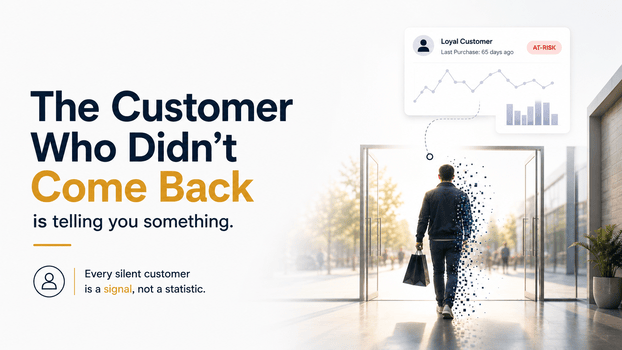
A few months ago, I sat with a retail brand's founder going through their monthly numbers. Revenue was up. New customers were up. Everyone on the call was in a good mood.
Then I asked a question that wasn't on the dashboard: “Which of your top 50 customers from last quarter haven't bought anything in the last 60 days?”
Silence. Nobody knew. Nobody had ever been asked to know.
We pulled the raw data manually that evening. Eleven of their best customers — people who used to buy every 3-4 weeks, spend well above average, the kind of customers every retailer builds a business around — had gone quiet. Not one system had flagged it. The dashboard was still green.
That gap is the thing I keep running into, across every retail business I've worked with. And it's not a data problem. It's a design problem.
Most retail dashboards are built to answer one question: They're very good at that. Revenue, footfall, average order value, category-wise sales — all present, all accounted for, all updated nightly.
But revenue is a lagging indicator of relationship health, not a measure of it. A business can hit its numbers this month using customers it will lose next quarter. The dashboard won't flag that, because from a pure sales lens, nothing looks wrong. The register still rang. The invoice still got cut.
What the dashboard doesn't do is separate from — and it almost never tells you which of your best customers just went quiet.
Think about what actually happens when a loyal customer stops coming back. They don't send an email. They don't call your support line to complain. They don't leave a bad review. They simply... stop. And absence, by its nature, doesn't generate a data point in a system built to track transactions.
This is the core design flaw in most retail reporting: it's optimized to record what happened, not to notice what stopped happening.
That founder I mentioned earlier wasn't running a bad business. Their POS, their inventory system, their sales reports — all solid. But every one of those systems is built around the transaction as the unit of truth. No transaction, no entry, no alert. The eleven customers who went quiet didn't trigger anything, because quitting isn't an event you can scan a barcode for.
There's a well-worn stat in retail: acquiring a new customer costs five to seven times more than retaining an existing one. Everyone quotes it. Fewer act on it, because acting on it requires infrastructure most businesses don't have — a way to actually see the drift happening, customer by customer, before it becomes a churn statistic six months later.
By the time “churn rate” shows up as a KPI in a quarterly review, it's a postmortem. In that founder's case, three of those eleven customers were, by the time we checked in again, gone for good — buying from a competitor down the street. The other eight came back once we simply reached out. One conversation. That's the entire gap between “lost forever” and “recovered” for most retail businesses: whether anyone noticed in time to have the conversation.
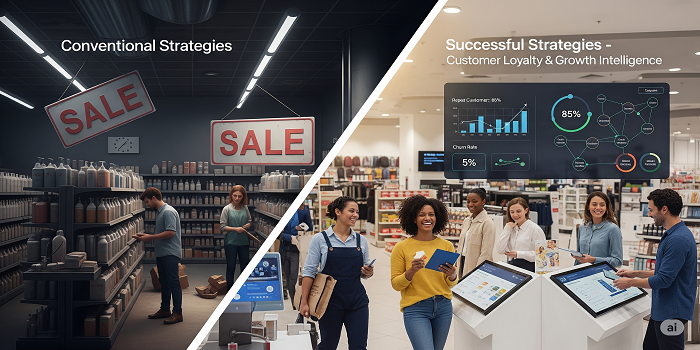
It's not about more dashboards or more charts. It's about changing the unit the system pays attention to — from the transaction to the customer.
Concretely, that means three shifts:
From aggregate trend to individual rhythm. “Footfall is down 3%” tells you almost nothing useful. Knowing that forty specific high-value customers who used to visit monthly haven't visited in two tells you exactly where to act.
From a snapshot to a lifecycle. A customer isn't just “active” or “inactive.” They move — new, growing, loyal, drifting, gone, and sometimes, won back. The moment that matters most is the quiet middle: loyal sliding into drifting, while there's still enough relationship left to pull them back.
From report to trigger. Insight that shows up after the customer has churned is a history lesson. Insight that shows up while they're still drifting — with enough specificity that someone can actually reach out — is the only version of this that changes the outcome.
None of this requires new data. It's the same purchase history, recency, and spend patterns every retailer already has. The difference is whether the system is built to organize that data around a person, or just around a receipt.
Next time you're in a Monday meeting looking at green numbers, ask a different question than usual. Not “what did we sell?” but:
“Which of our best customers went quiet this month, and did anyone notice?”
If nobody in the room can answer that with a name, a number, and a reason to act — that's not a small gap. That's the gap where next quarter's revenue is quietly leaking out, one silent customer at a time.
The customer who didn't come back already told you something. The only question is whether your systems were built to listen.
LYTTY brings all of this together in a single platform, purpose-built for retail. Whether you are a fashion house, a pharmacy chain, a jewellery brand, or a D2C business looking to deepen customer relationships, LYTTY gives you the tools to build loyalty that drives measurable, sustainable repeat revenue.
Curious how this lands for others building or running retail businesses — is tracking “quiet” customers something your team does deliberately, or is it still a gut-feeling thing? Would love to hear how you approach it.

Download the D2C Bank Account Freeze Survival Checklist (Free PDF) and get practical steps to protect your bank account freezes caused by fraudulent transactions.
Thank You! Your Freeze Survival Checklist is on its way
While you're here, don't stop at prevention - learn how leading D2C brands are using LYTTY to :
Or